
Precision meets performance: Quality solutions for fuel cell & electrolyzer production
Hydrogen is emerging as a cornerstone of the global energy transition. From heavy-duty trucks and buses to stationary power systems, PEM fuel cells offer a zero-emission alternative where batteries reach their limits. But as the industry moves from prototype to series production, a new challenge takes center stage: How do you manufacture millions of fuel cells with the consistency and reliability that automotive and industrial customers demand? The answer lies in process control. Fuel cell manufacturing involves handling some of the most delicate materials in the energy sector. From ultra-thin polymer membranes and precisely dispersed catalyst layers to porous gas diffusion media. Even microscopic defects or minimal layer misalignment can compromise cell performance and durability.
BST brings proven expertise from high-precision web processing industries to fuel cell production. Our sensor technology, automation systems, and inspection solutions are engineered for the specific demands of membrane electrode assembly where tolerances are measured in micrometers and quality is non-negotiable.
Coating
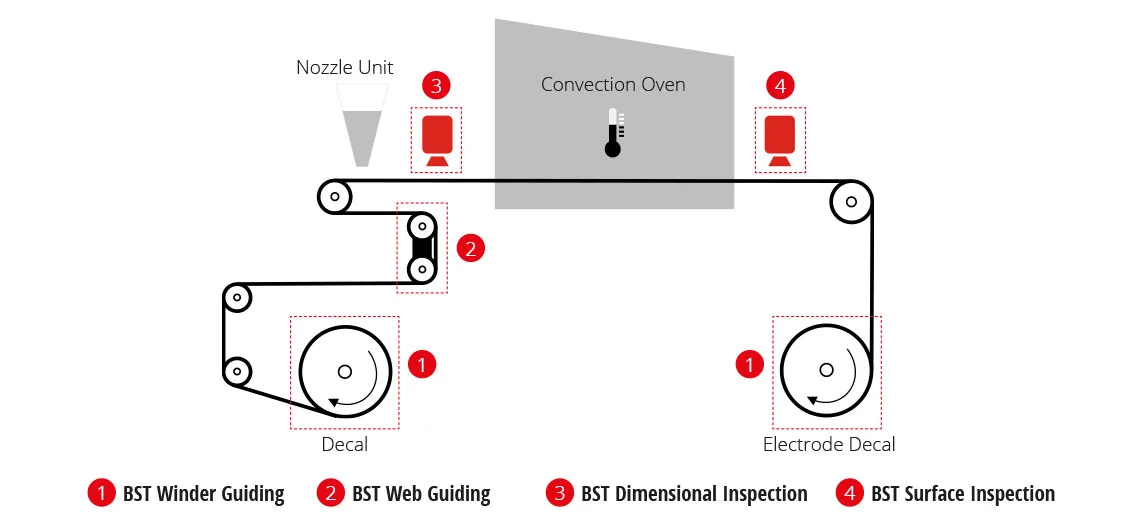
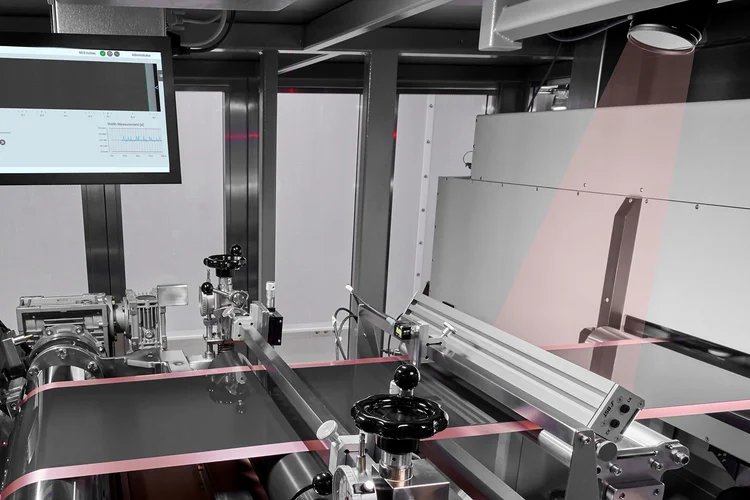
Applying the catalyst layer is one of the most critical steps in fuel cell manufacturing. Whether using slot-die coating, gravure, or decal transfer methods, the challenge remains the same: achieving uniform catalyst distribution with precise edge definition and minimizing the use of expensive platinum-group metals. Coating irregularities such as pinholes, thickness variations, or edge defects directly impact fuel cell efficiency and lifespan. BST COATINGControl® enables real-time monitoring of coating position and quality, detecting deviations before they propagate downstream. Our web guiding systems ensure stable substrate transport even at high line speeds, while winder control maintains consistent tension across sensitive membrane materials. iPQ-Surface ENERGY adds a layer of 100% defect detection identifying particles, scratches, and coating anomalies that could compromise the finished cell.
CCM Assembly
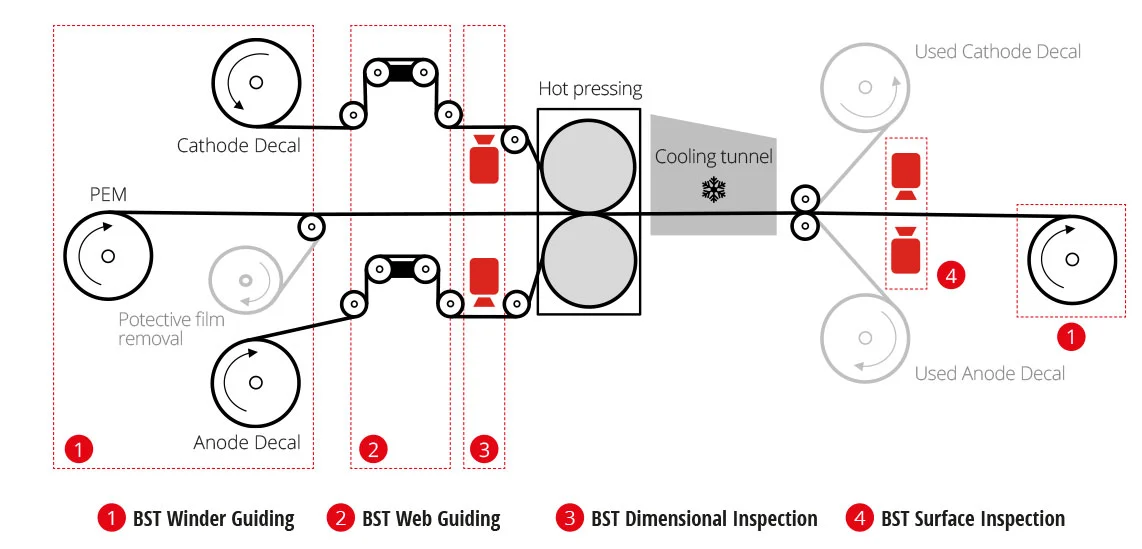
The catalyst coated membrane is the electrochemical heart of every PEM fuel cell. During CCM production, anode and cathode layers must be precisely aligned on opposite sides of an ultra-thin polymer membrane. Any misregistration between layers reduces the active area and degrades cell performance. Hot pressing and lamination processes add further complexity: temperature and pressure must be carefully controlled to ensure proper bonding without damaging the delicate membrane structure. BST's web guiding and winder control systems provide the positioning accuracy needed for reliable layer-to-layer registration. Dimensional measurement verifies geometric precision in real time, while iPQ-Surface ENERGY monitors both sides for surface defects and contamination which is critical for maintaining membrane integrity.
Subgasket Application
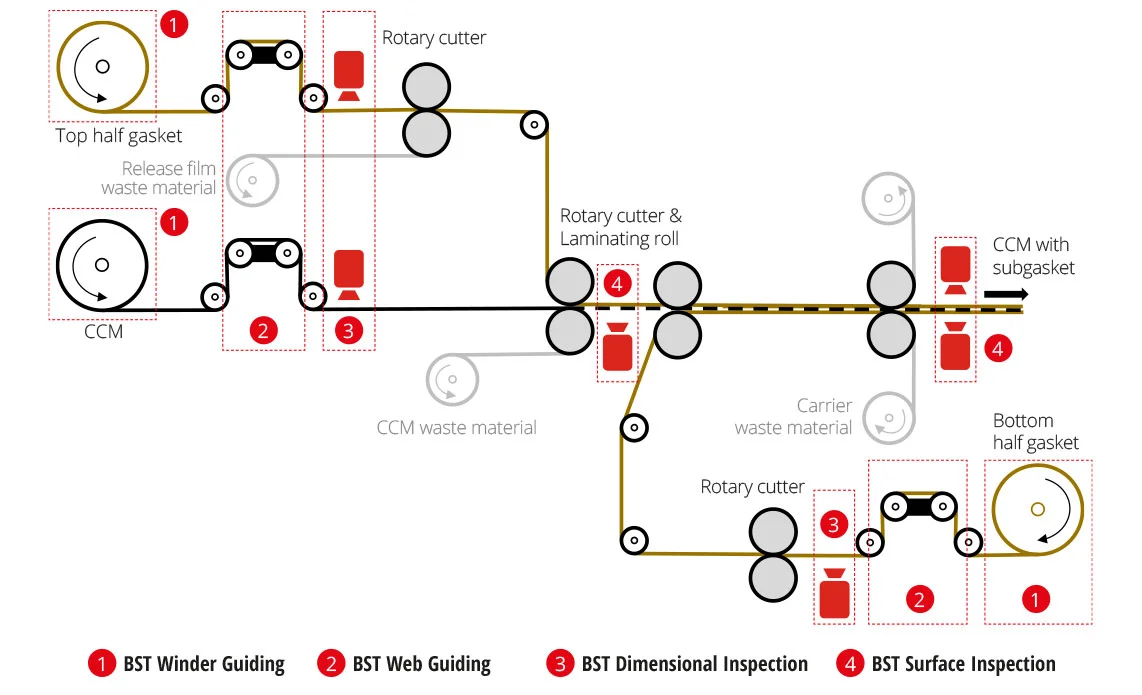
The subgasket defines and protects the active area of the CCM while creating the sealing surfaces needed for stack assembly. Precise placement is essential: gaps or overlaps between subgasket and active area can cause gas leakage, membrane degradation, or reduced cell performance. Modern fuel cell production uses roll-to-roll processes for subgasket application, requiring tight control over material positioning and lamination accuracy. BST web guiding ensures exact material placement, while winder control prevents tension variations that could stretch or distort the substrate. CELLInspection and iPQ-Surface ENERGY provide comprehensive quality verification, checking for placement accuracy, adhesion defects, and foreign particles. Dimensional measurement confirms that every subgasketed CCM meets specification before moving to final assembly.
MEA Assembly
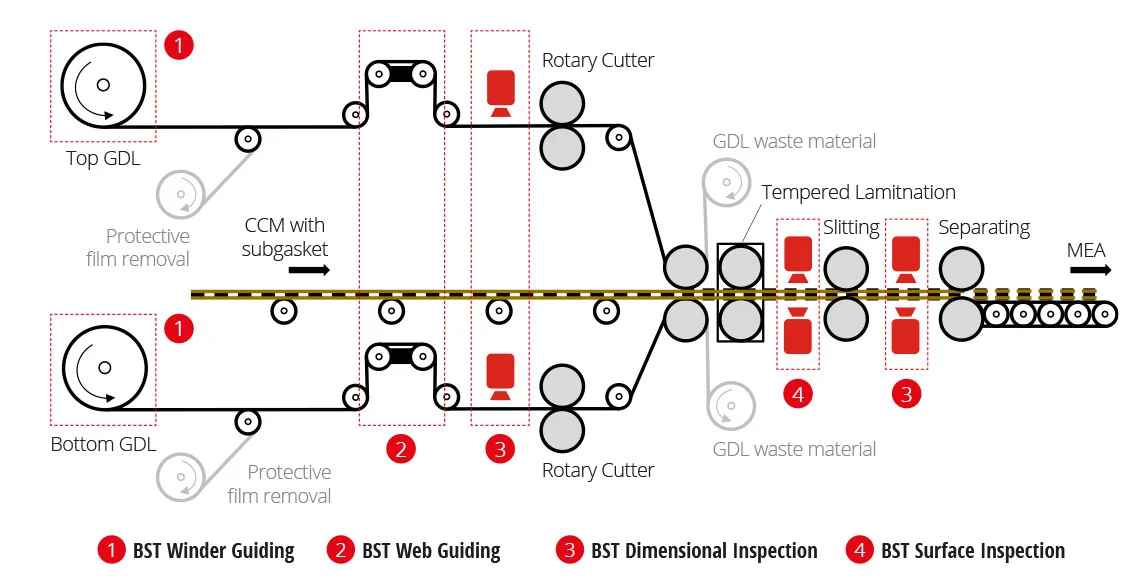
In the final assembly stage, subgasketed CCMs are combined with gas diffusion layers to create the complete membrane electrode assembly. This multi-layer laminate requires exceptional precision: each layer must be accurately positioned and aligned to ensure uniform gas distribution and electrical contact across the active area. BST addresses this challenge through networked BST web guiding systems with master/slave and offset correction functions enabling precise alignment of transparent, translucent, and opaque materials in a single process. BST SLITTINGControl® ensures accurate slitting to final dimensions, while iPQSurface ENERGY and CELLInspection verify surface quality and detect defects across all layers. The result: MEAs that are ready for stack integration with documented quality data for every unit produced.
Contact us today for a personalized consultation or product demonstration.
Our products for fuel cell
-

Основой эффективности и качества производственных процессов с использованием рулонного материала является точное и стабильное ведение полотна.
-
Обеспечивает идеальное прилегание покрытия к основанию
-

Контролирует и оптимизирует процессы продольной резки в режиме реального времени, обеспечивая точное определение точек реза
-
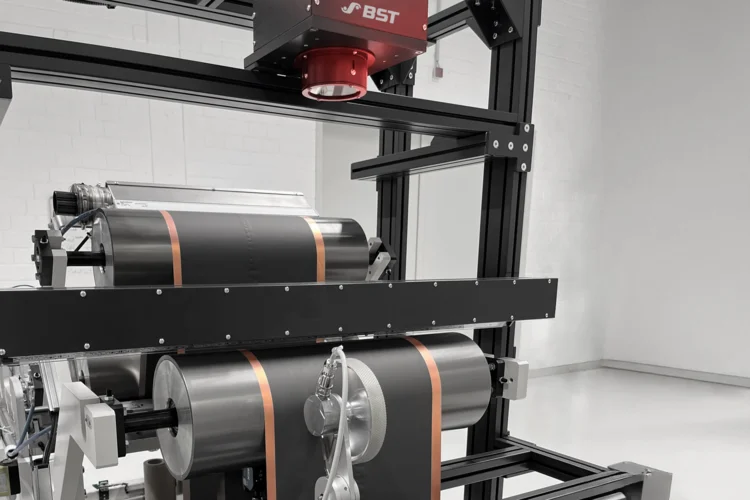
Контроль электродов с покрытием с помощью специализированного высокотехнологичного решения для рынка новых источников энергии
-

Центральная платформа для цифровизации и автоматизации вашего производства.
-

In many production environments, efficiency losses remain hidden due to a lack of process transparency.
A structured machine analysis makes processes measurable, identifies optimization potential, and defines concrete measures to increase efficiency.
- Identify weak points in the process
- Make relevant process parameters measurable
- Define and prioritize concrete optimization measures
Fuel cells are a key technology for decarbonizing the economy. We look forward to addressing current and future challenges in the production of fuel cell systems with our innovative products to further drive the expansion of sustainable energy systems.
Florian KortekampDirector Industry Management New Energy